The evening before, you don’t know what you’ll eat. Your chef hasn’t decided yet.
He decides in the morning. At the market.
That’s the rule, and it’s what makes everything possible. Off-Menu only works if the chef is free to be himself. Free to choose based on what he finds that day, what his producers saved for him, what moves him at six in the morning when he’s standing over a crate of vegetables in the cold.
You’ve received a message the night before. An address. A time. What to wear or not to wear. That’s everything you know.

At the Halles, before service.
The Halles Paul Bocuse are a covered market in Lyon’s 3rd arrondissement, and at that hour they belong to the trade. Chefs, not shoppers. You are there too, not as visitors but as the people someone brought along to do the buying.
The chef isn’t narrating. He’s looking, touching, asking his producers questions. He talks about last week, about rain in the Monts du Lyonnais, about the truffle delivery coming Friday. You understand this relationship has been running for years. That the best produce is set aside for him before the Halles open to the general public.
This is the first thing you couldn’t have accessed without him. Lyon doesn’t give itself up to people who just show up. It reveals itself through relationships built over years. You’ve just been let into one.
Lyon doesn’t give itself up to people who just show up. It reveals itself through relationships built over years. You’ve just been let into one.
The kitchen.
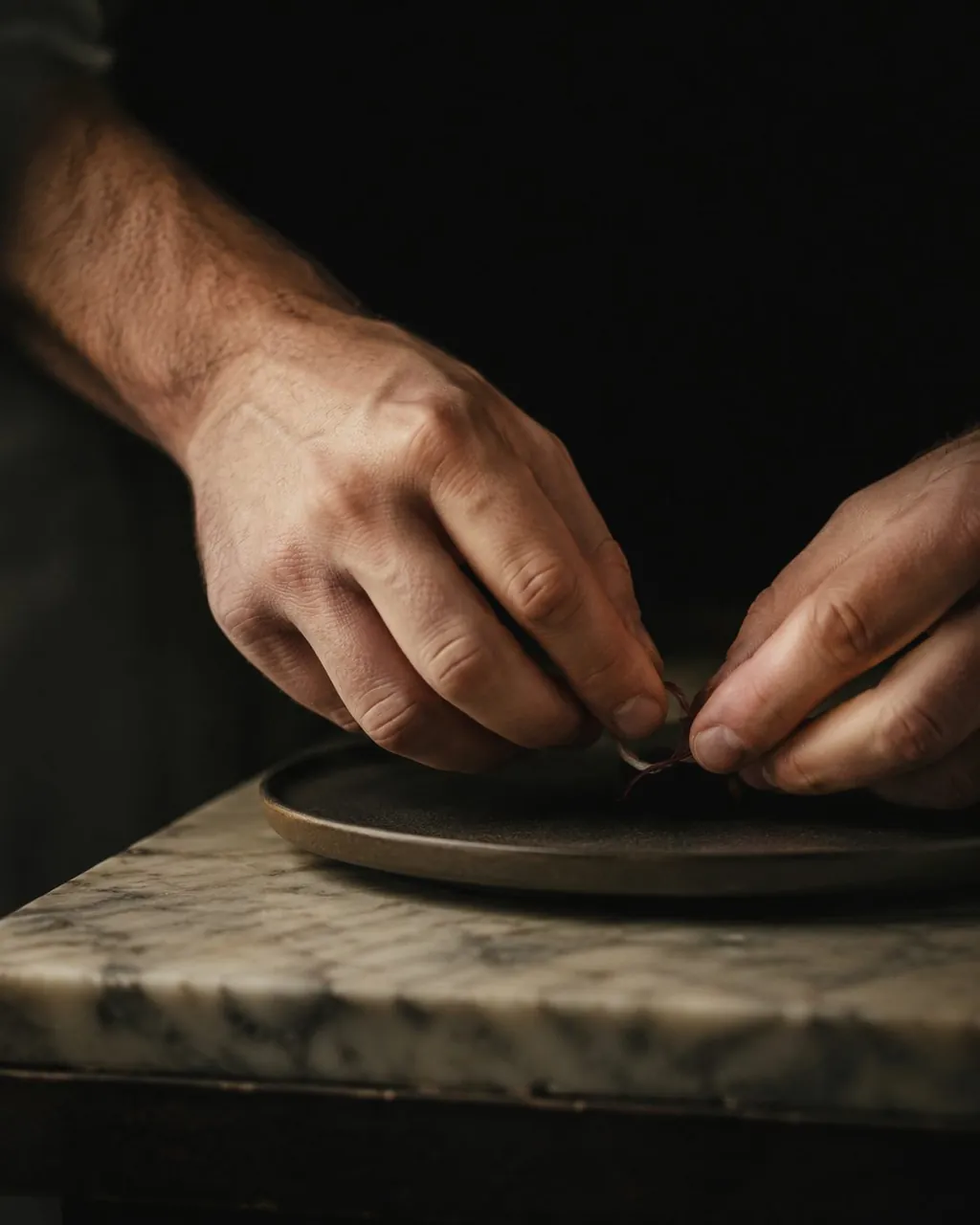
There’s no staging in the kitchen. There are knives left out, a cutting board worn down by years of service, a radio playing something no one is really listening to because everyone is watching his hands. Six people in a space not designed for six people. That’s exactly why it works.
He might cook a Dombes pike perch with beurre blanc. Or a Bresse chicken poached in a stock that’s been going since midnight. Or a tart with berries picked that morning at a farm forty minutes from Lyon. You still don’t know. That’s not what the evening is about. The evening is about being there while it’s happening.
Some people cook alongside him. Others watch. Others sit on the counter and listen to the chef talk about Lyon, the restaurants he loves, the ones he doesn’t, the years he trained in Paris before coming back. No one asks about techniques. People talk about what friends talk about.

The table.
Dinner happens at the kitchen workbench, cleared for the occasion. Or in the dining room after the last service, chairs still in their evening position. Or in a room in a farmhouse in the Beaujolais, with a fire that’s been going since four o’clock.
There’s no service in the formal sense. The chef plates himself. He sits down sometimes. He pours a glass. The conversation started at the market and there’s no reason it should stop. That’s why there’s no scheduled end time. An Off-Menu evening ends when it ends.
What you ate, you won’t find on a menu anywhere. The chef cooked it for you, tonight, with what he found this morning. If you come back in six months, it will be something else entirely. That’s the nature of the thing.
What stays.
It’s not a restaurant memory. It’s not a great meal. It’s something harder to name. You spent an evening inside someone’s life. Not a recreation of it. The real thing, with his real places, his real people, his real way of cooking.
You borrowed an intimacy that didn’t belong to you. And the chef gave it, not because it’s his job, but because it’s what he chose to do that evening with six people he hadn’t met before.
Six people. Never more. That’s the only rule that won’t change.