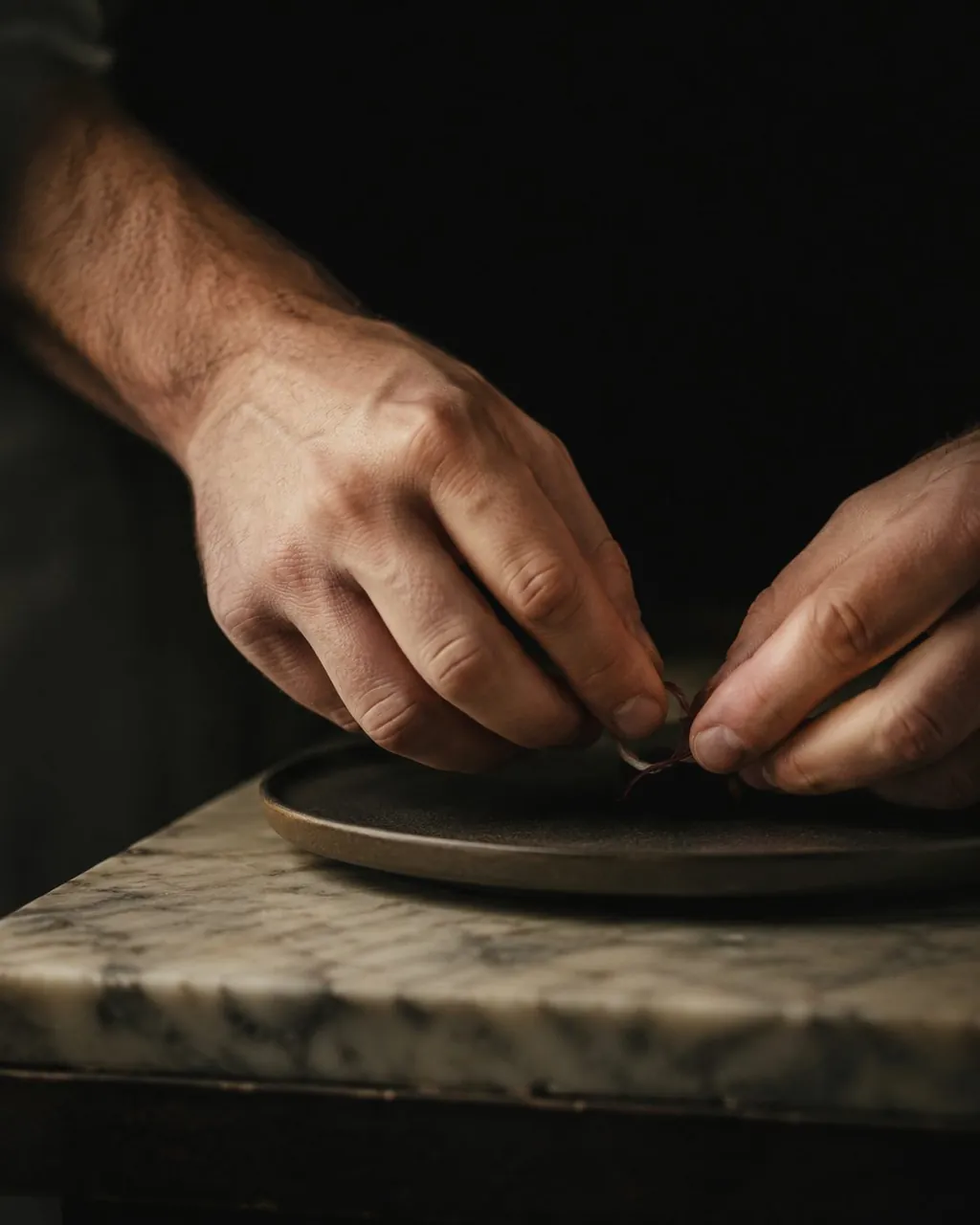
You see it before you see the man. A thin band of blue, white and red at the collar of the whites, and nothing else. No badge, no plaque, no sign above the stall.
It is the collar of the Meilleurs Ouvriers de France. The competition is a state examination, held every four years, trade by trade. A jury sets the subject, the candidate works for hours in front of it, and either the jury awards the title or it awards nothing at all. There is no second place, and there are years where a trade produces no laureate.
You cannot buy it. You cannot be given it. In France the title is protected: wearing the collar without having sat the examination is an offence, which is why nobody does.
The tricolour collar is not worn. It is won.
Lyon counts more of them than a city its size should. Not because Lyon is more gifted, but because the trades here still sit next to each other. In the Halles Paul Bocuse alone, a butcher, a cheesemonger and a pastry cook can all be laureates, twenty metres apart, in the same aisle, on a Tuesday morning.
What it looks like at the block
It looks like speed, and it is not speed. A poultry is trimmed in a handful of movements, and each of them is decided before the knife moves. The bird is blowtorched, the last quills come away, the joint is opened where it wants to open. Then the man explains why he cut there rather than a centimetre to the left, and you understand that the explanation is the point, and the gesture is only its proof.
Nobody in the aisle looks up. In a market that has three of them on the same row, a laureate at work is Tuesday.
Why it matters to a table
Because it is the part of Lyon that does not travel. A recipe travels, a producer's name travels, a photograph travels. Fifteen years of a relationship between a chef and the man who trims his poultry do not travel, and cannot be bought on the morning you need them.
That is what you walk into. Not a market, but a set of relationships that took a career to build, opened for one morning.